[Motor Prototyping Service Guide] Think Motor Design is the Only Thing that Needs Validation? Incoming Material Quality is the Hidden Key to Manufacturing Yield
[Motor Prototyping Service Guide]
Think Motor Design is the Only Thing that Needs Validation? Incoming Material Quality is the Hidden Key to Manufacturing Yield
In an era of increasingly fierce competition in the electric vehicle and robotics markets, the ability to rapidly complete prototype validation and acquire reliable data often dictates who can launch first and dominate the market. GMW's motor prototyping service is engineered specifically to help advanced R&D teams accelerate this crucial design validation process.
What is the Motor Prototyping Service, and Why is it the New Key for R&D Teams?
According to Fortune Business Insights data, the global electric motor market is valued at $176.49 billion in 2026 and is projected to grow to $258.17 billion by 2034.
Faced with this explosive market expansion, most high-level R&D teams encounter significant challenges during the initial stages of motor development. These include high equipment investment thresholds, long development cycles, and a substantial "Design to Manufacturing Gap." Therefore, a "Motor Prototyping Service" has increasingly become the critical solution for R&D teams to mitigate risks, accelerate validation, and successfully complete pre-production prototyping and pre-investment trials before scaling up to mass production.
Global Electric Motor Market Size Forecast
Source: Fortune Business Insights
Global market size in 2026
Projected market size by 2034
CAGR (2026–2034)
2. Bridging Design and Manufacturing: The Crucial Role of Design for Manufacturability (DFM)
Many R&D teams fall into a common trap during the prototyping phase: they assume that a flawless electromagnetic design guarantees seamless production. However, they often overlook that motor manufacturability validation depends not only on the design itself but is also inextricably linked to the quality of the components provided by the supplier system. If the incoming material quality from suppliers is unstable, it directly results in poor manufacturing consistency and low yield rates.
In this context, "assisting clients in evaluating incoming supplier material quality upfront" becomes an exceptionally valuable secondary benefit of GMW's prototyping service. It helps clients uncover hidden supplier pitfalls early in the development phase. Whether you are developing BLDC motors, Drone motors, AGV motors, or EV motors, we can help safeguard your quality.
3. DFM Practical Analysis I: Validating "Green Powder Coating" Durability Under a 75% Slot Fill Factor with Multi-Wire Winding
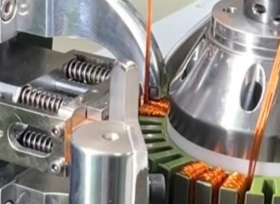
To pursue higher torque and power density, heavy-payload drone motors often push the slot fill factor to nearly 75%, combined with a multi-wire parallel winding design. Under such extreme design parameters, the quality of the insulation coating (green powder) and the stator specifications directly impact the execution of drone motor winding technology and overall manufacturing stability.
During actual prototyping, if the supplier's green powder coating thickness is uneven or the film's durability is insufficient, the high-tension, high-density multi-wire winding process on automated equipment can easily cause the wires to rub and pull against each other. This leads to coating damage and peeling, which severely affects the drone motor's winding precision. Not only does this cause phase-to-phase short circuits, but it can also result in fatal power failures in the field.
Through DFM validation, the GMW team implements a "phase-to-phase pause" after winding each phase to manually inspect whether the wire starts, ends, and inter-slot crossovers present any anomalies. This serves as an integral part of our process error-proofing; if coating flaking is detected, we provide immediate feedback to the client and assist in fine-tuning winding tension parameters, thereby eliminating hidden risks prior to mass production.
4. DFM Practical Analysis II: Jig Fine-Tuning to Overcome Variations in Incoming Inner Diameter Tolerances

Beyond insulation coatings, the machining tolerances of metal components are another focal point of DFM validation. In automated winding processes, we frequently encounter variations in the "inner diameter tolerance" of stators provided by suppliers.
When incoming inner diameters deviate (e.g., tolerance shifts that fail to meet the drawing specifications), the stator cannot be smoothly inserted into the automated winding machine's stator base, causing jig "clamping interference". This misalignment compromises winding positioning and directly leads to production line halts.
Faced with incoming material variance, the engineering team remeasures the actual dimensions and incorporates this real-world variance into the jig design, recalculating and widening the positioning slot tolerances. By transforming every incoming material issue into an optimized process experience for the next run, we ensure the stability of subsequent mass production.
5. GMW: Motor Manufacturability Experts Helping You Transition Seamlessly from Design to Mass Production
Leveraging years of experience in manufacturing winding equipment, GMW has built a "Motor Prototyping Service" platform tailored for R&D teams. Our mission is to help clients factor in mass production conditions during the early design phase, avoiding downstream development delays caused by a lack of manufacturability.
Why shouldn't you ignore "upfront manufacturability validation"? Because partnering with GMW provides the following irreplaceable advantages:
①Zero Equipment Investment to Start
Focus on your design without investing in expensive production equipment; we handle the realization.
②Mass Production Equipment Validation
Our facility is equipped with multiple ready-to-use winding machines, allowing us to produce various stator samples directly.
③Incoming Material Quality Control
Through prototyping, we help you evaluate supplier material quality upfront, weeding out hidden threats to production stability and reducing the risk of sample failure or rework.
④Low-Risk Validation
Sample stability and quality can be directly benchmarked against mass production standards. Combined with comprehensive visual, withstand voltage, and R/L data tracking, we significantly increase your success rate in transitioning to mass production.
⑤Shortened R&D Cycles
Overall development time can be reduced by approximately 30% (saving weeks to months).
GMW helps you achieve rapid prototyping with "zero equipment investment," seamlessly bridging design validation and mass production!
Is your heavy-payload drone motor preparing to enter the prototyping or pilot run phase? Let GMW help you build the most reliable foundation for mass production, from blueprint to sample.
Fill out our contact form to schedule a professional motor prototyping technical consultation.6. The Workflow for Co-Developing Prototypes with GMW
Our streamlined and efficient workflow ensures you receive mass-production-grade samples quickly.
Submit Design Requirements
Client provides drawings
→Free Evaluation
GMW prototyping quote & assessment
→Parameter Setup & Production
Tooling/parameter setup → sample production
→Performance & Quality Testing
Winding quality inspection
→Submit Prototype Report
Samples & mass production recommendations
FAQ
A: This service is especially suited for advanced R&D teams in the early stages of motor development who need to accelerate prototype validation. It helps clients bridge the design-to-manufacturing gap by enabling critical "pre-production prototyping" and "pre-investment trials" with zero equipment investment.
A: Our validation and prototyping services specialize in the following high-performance applications:
- Drones (Outrunner): Drone motors for agricultural, commercial, and military applications that demand extreme power density, lightweight construction, high slot fill factors, and high-speed winding tension control.
- Robotics (Servo): Joint servo motors for humanoid robots, quadruped robot dogs, and collaborative robot arms requiring high torque density and extreme space-constrained designs.
- AGV / AMR (Hub Motor): Autonomous mobile logistics vehicle drive hub motors focused on high load capacity, shock-resistant structures, and long-term operational stability.
- E-Mobility: EV motors, EV scooters, and e-bike motors striving for high starting torque and extended range.
A: No. GMW develops prototypes based on the parameters of our mass production equipment, ensuring that the samples closely reflect actual mass production conditions.
A: Assuming drawings and specifications are confirmed without issue, prototype manufacturing and initial testing are typically completed within an average of 2 to 3 months (depending on motor design complexity and slot fill factor requirements). In practice, we often find that supplier incoming material quality is the hidden killer that delays prototyping schedules. Through GMW's professional DFM evaluation and jig fine-tuning capabilities, we can respond swiftly when material anomalies are detected, saving you rework time spent communicating back and forth with suppliers and ensuring your project stays on track.
A: Through professional winding technologies, we provide solutions that maximize slot fill factors and minimize losses, optimizing BLDC motor design efficiency. Incorporating "manufacturability" at the initial design stage ensures optimized motor performance and is the key to countering high cost challenges.